As the Games Industry has grown over the years, the climate has also changed alongside this to where the industry growth has affected environmental impacts from new emerging technology. The new technology includes new console hardware, cloud-based tech and, more recently, blockchain tech through introducing NFT (Non-Fungible Token) to games.
The first impact that the biggest is hardware manufacturing through developing a new console and creating physical discs to insert into the console and play games. Creating a console requires materials that are mined, such as:
- Copper
- Nickel
- Gold
- Zinc
One of the problems that have been brought before is where these materials had been mined from, as some had not been traced. This is a problem because some suppliers do not consider the environment as mining is the most damaging part of its impact. However, some companies like Nintendo have tried to avoid specific suppliers when manufacturing hardware, but the Sony Playstation 4 has produced over 8.9 billion of CO2 since its release back in 2015. While mining resources can be dangerous to the environment, it does allow the means to make more powerfully hardware so that new games and development can be produced for the industry.
The current generation’s physical discs are Blu-Rays made of special Polycarbonate from Polymer. Previously, DVDs were used from Polypropylene which was heavier on the resources due to oil and gas in their production. While Blu-Rays are more environmentally friendly, they still require plastic to produce to store games onto the discs. The Games Industry has found a better way to store games through the means of digital and cloud-based tech.
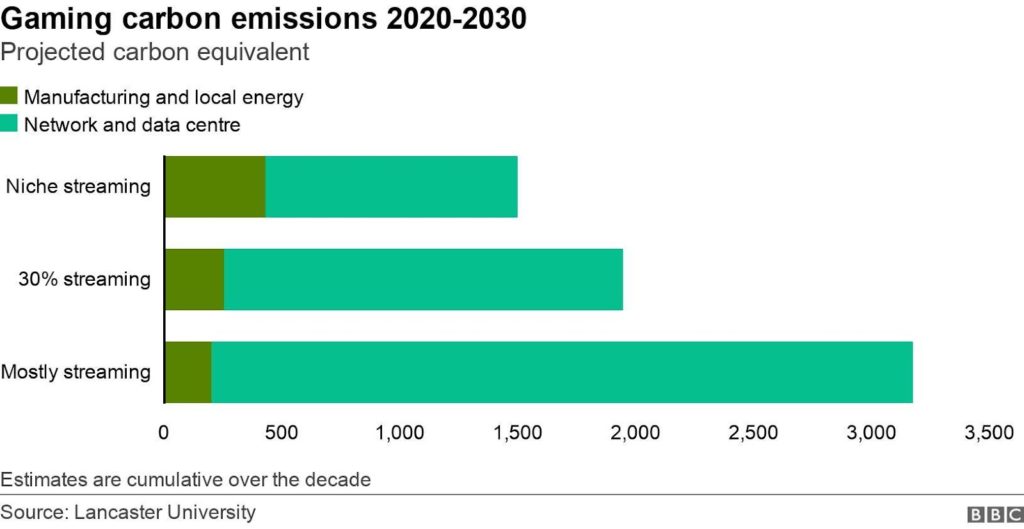
The benefit of using digital and cloud-based tech is that fewer resources are not wasted since physical discs are not created to produce the game. It also reduces the amount of carbon footprint to getting a hold of the game since you can access the game directly through the server to download or streaming services. However, this does come at the cost of more energy to produce for the server to run, as many players will access the server to download the game or play any Games as a Service. Already, streaming games have become more popular since 2020 through most players streaming and as a result, fewer people are purchasing physical copies of games. The result can be seen below.
Finally, the Games Industry has recently started exploring introducing blockchain technology through the use of NFT. So far, the technology has not gotten too successfully in the industry due to mixed reviews around the concept. Still, some companies like Ubisoft are trying to push the technology forward for it to be used in games. While blockchain has not properly kicked off into the industry, there is growing concern about the environmental impact it has because it involves energy usage. This includes creating, transferring and tracking the resources. Several factors can affect the energy consumption of NFTs; however, a single NFT can generate more carbon dioxide than driving for around 500 miles around the planet.
While the market of NFT is not popular with players due to their focus to play games for fun, the industry still wants to push the tech forward but must require a way to make blockchain less impactful to the environment. The Games Industry can support NFT by using the blockchain protocol of “proof-of-stake” over “proof-of-work”, a protocol currently used by Ethereum and Bitcoin. Proof-of-work ensures a secure transaction is done by requiring crypto miners to problem-solve computationally for the transfer, which consumes more energy in the process. However, the proof-of-stake transaction is done through the miners having to stake their own resources to validate the chain. By using proof-of-stake, less energy can be consumed, but it does not solve the issue it has around the environment. To get around this is to build in renewable energy sources to help with carbon emission and deliver a cost-saving method.
As a player, to help improve the environment toward becoming more sustainable is to:
- Switch off any PC/console when not used, which consumes energy.
- Look into purchasing digital games rather than physical, reducing carbon footprints and less need for plastic.
- Do not throw away the hardware if you plan to upgrade your console/PC hardware. Either resell, donate or recycle it as they contain valuable materials that can be recycled, such as plastic, silver and gold.
While the above can make a difference for a player who enjoys playing video games, the Games Industry of the many studios will need to play their part to make a difference to the environment. They can do this by encouraging more people to work from home by using online tools and by switching energy providers that offer greener energy. The benefit of doing the above is that it allows studios to recruit many people worldwide since they would be required to visit the studio. Also, it reduces the number of carbon footprints around people needing to get to the studio, and the studio saves costs around using energy, which the extra can help for recruitment.
Bibliography:
Codas, M (2020) Our Movie Collections Are Killing the Planet, And Here’s How. Available at: https://www.dreadcentral.com/editorials/335206/our-movie-collections-are-killing-the-planet-and-heres-how/ (Accessed 15 May 2022.)
Flecther, C (2021) Sustainability and the Video Gaming Industry. Available at: https://earth.org/sustainability-and-the-video-gaming-industry/ (Accessed 15 May 2022.)
Tomasulo, A, M (2022) Play Greener: Solutions to Offset the Environmental Impact of Videogame NFTs. Available at: https://www.winston.com/en/the-playbook/play-greener-solutions-to-offset-the-environmental-impact-of-videogame-nfts.html (Accessed 15 May 2022.)